Role

Service design at platform scale

As Principal Designer for Farfetch's platform products, the tools 1,400+ luxury boutiques and brands use to sell on Farfetch, my role was to bring service design into how product teams worked. That meant leading discovery on complex, cross-team problems, and coaching teams in Jobs to be Done and service blueprinting so they could take shared ownership of the partner's end-to-end journey. The three examples below show the kind of work the role involved.

Role
Principal Designer, Platform Products
Company
Farfetch
Dates
2018 to 2020, 2022 to 2023
Remit
Platform Products, reporting to the Director of Product
Garments in white covers on production rails, each tagged with numbered orange labels showing the partner boutique and category

Examples of the work

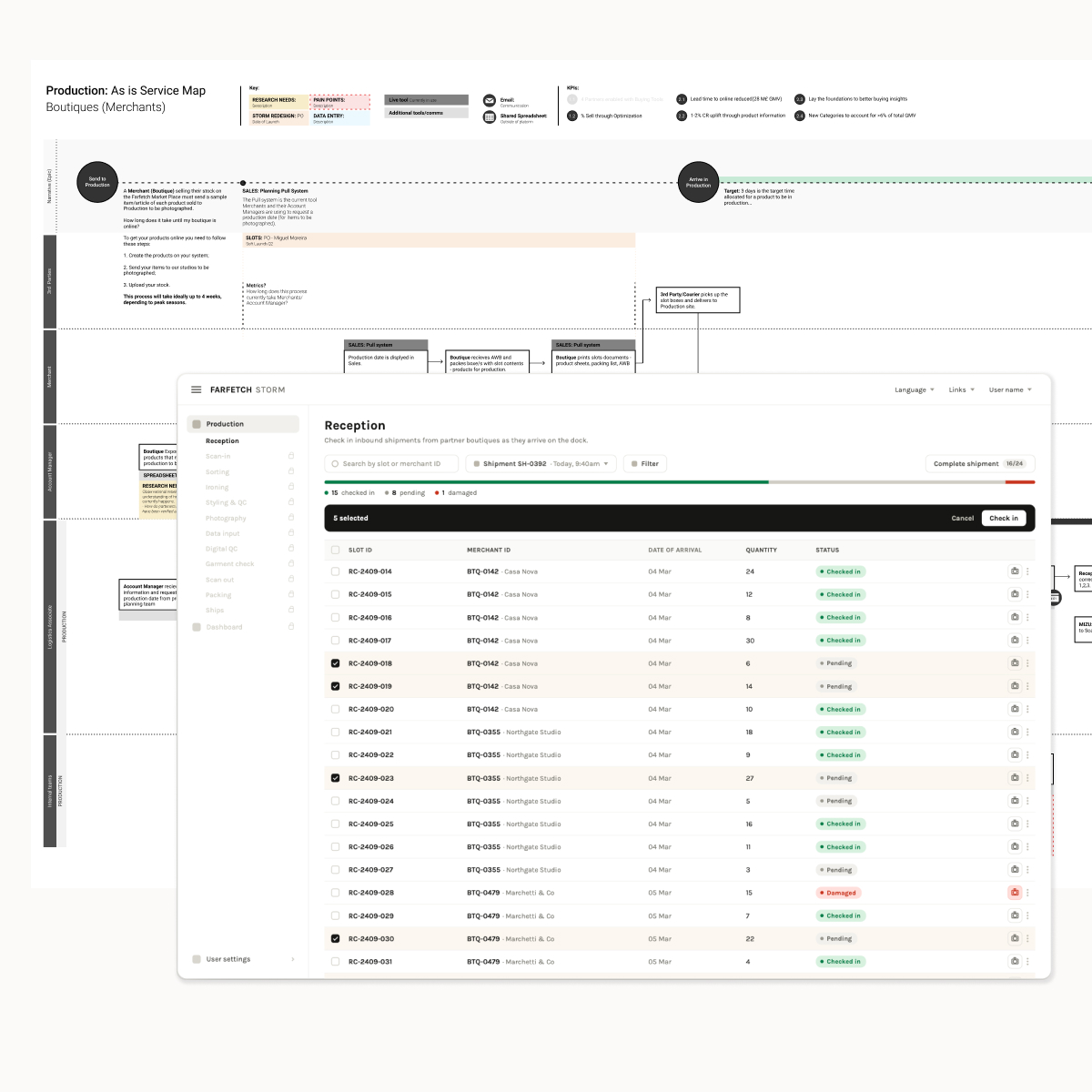
Production as-is service map for boutiques, with a screen from the new Storm production tool laid over it: the Reception view, where inbound shipments from partner boutiques are checked in slot by slot, each marked checked in, pending or damaged

Production tooling, time to online

Exposing the service debt of internal complexity

The brief was to redesign the layers of disconnected tooling that made up the production workflow, handling up to 3,000 items a day at one of the most sensitive points in Farfetch's operation. My role was to reframe it as a service challenge, not a tooling one. The business measured success by time to online, a seven-day target with three days in production, and reducing it was tied to £28M in GMV. Partners measured it by when their stock came back, a process that could take up to four weeks, with no status on its progress in between. The discovery set the strategy for the new tooling, and the partner side became its own project: a PIM (product information management) tool designed by my team. This kicked off a four-year programme across the Merchandise Management domain.
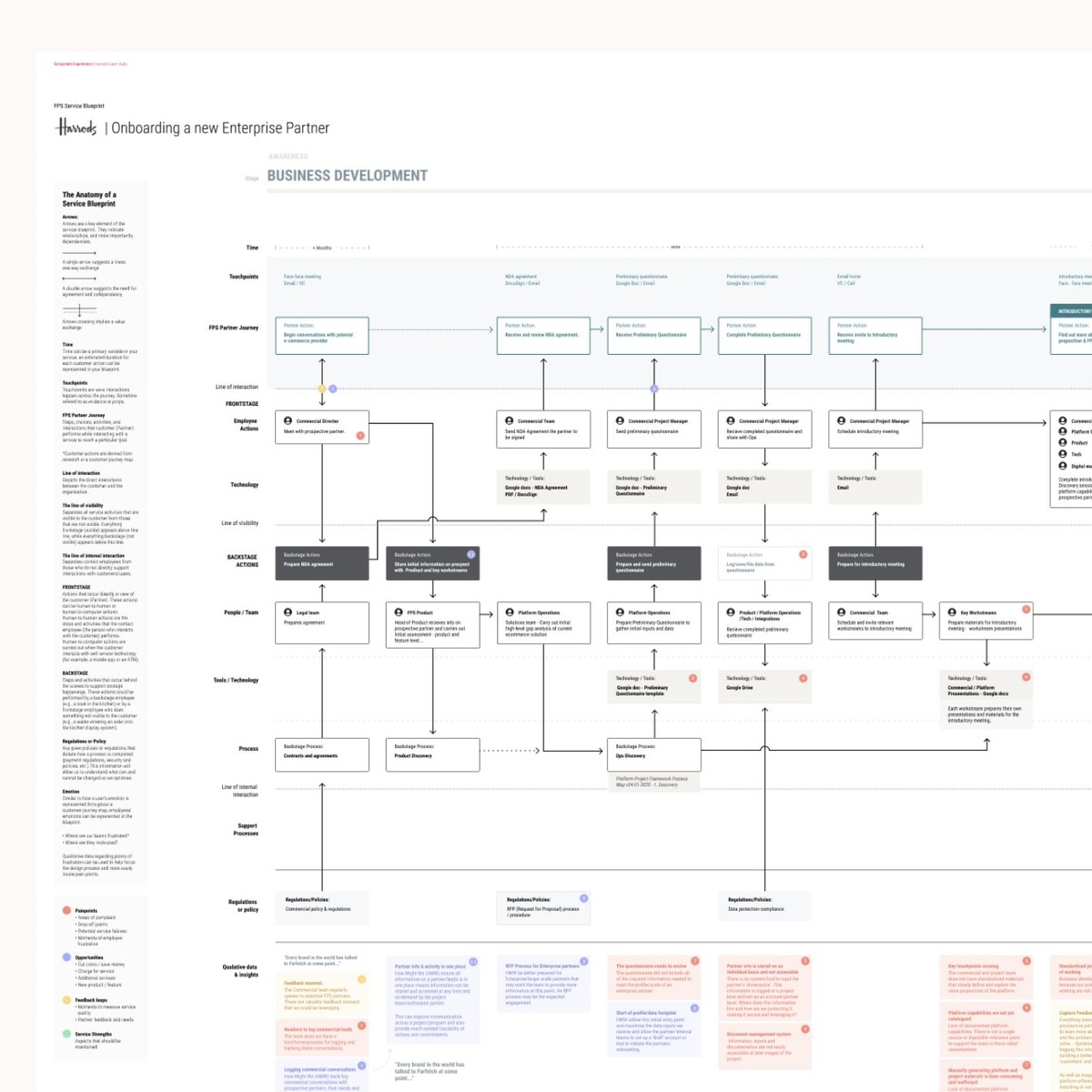
Harrods service blueprint, Onboarding a new Enterprise Partner, at the business development stage: the partner journey above the line of interaction, with employee actions, backstage actions, teams, tools, processes and policies below, beside a legend explaining the anatomy of a service blueprint

Enterprise partner onboarding

Making the hidden cost of onboarding visible

Onboarding Harrods took two years and absorbed around 80% of Product's capacity. Alongside the commercial team's own retrospective, there was a need to capture the experience of the product and operations teams too. I was tasked with providing an independent view. I mapped the onboarding end to end, from what the partner saw to the core systems and teams behind it. That surfaced the operational gaps and the impact on the teams involved, not just the product and tooling pain points. For the first time, the platform team had one view of what it takes to onboard a partner of Harrods' size, built by the people who did the work. It became the starting point for planning, costing and managing risk on the roadmap for future enterprise partners.

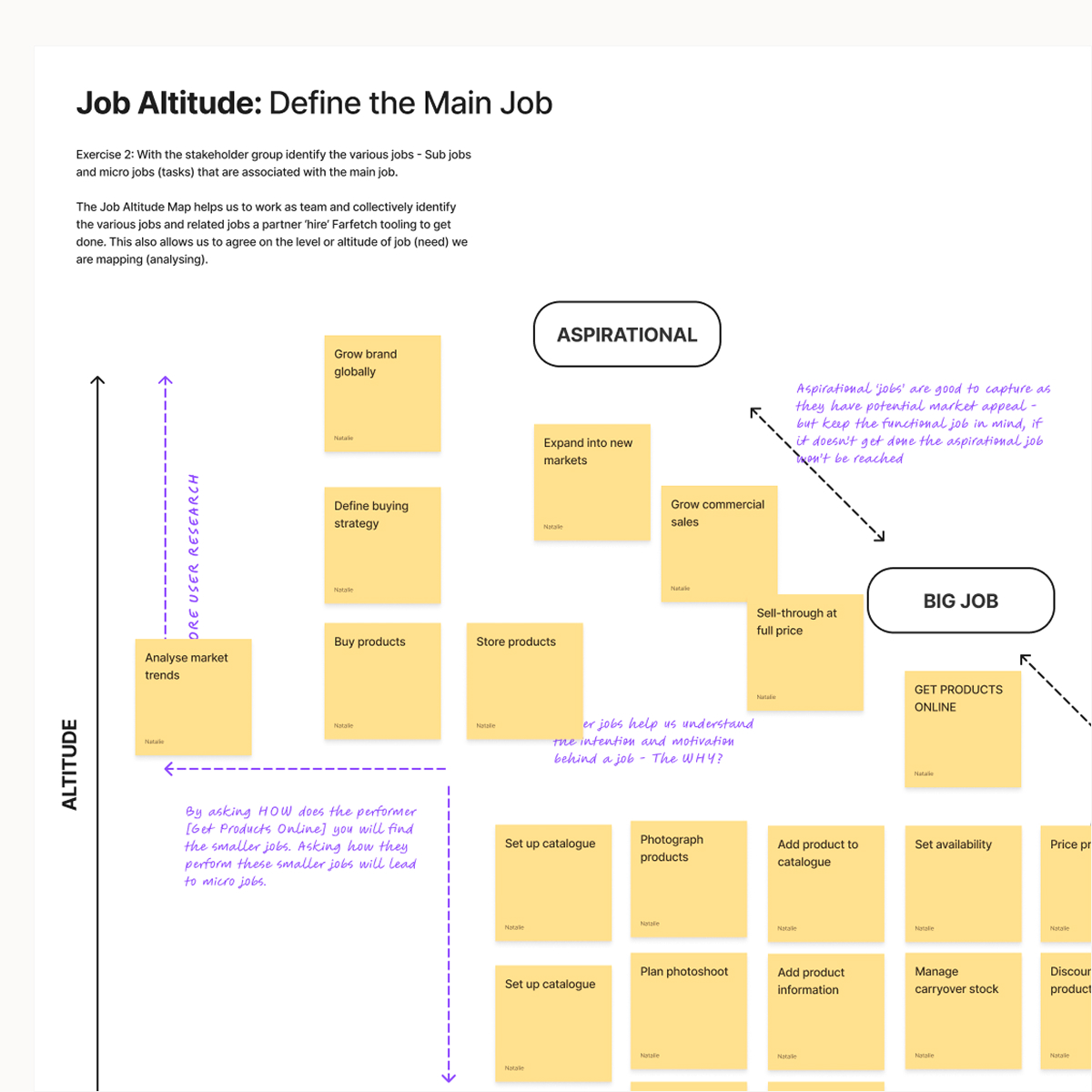
Job Altitude map, Define the Main Job: sticky notes ranging from aspirational jobs such as Grow brand globally down to the big job, Get products online, and the smaller jobs beneath it, with handwritten coaching notes

Service transformation

Operationalising customer-centricity

With a pipeline of high-profile partners about to join, leadership was concerned that known gaps in the B2B suite would hit KPIs and profitability, and increase the cost of manual processes. Teams were organised around individual tools rather than the service a partner experienced, so problems that fell through the gaps kept resurfacing without anyone tackling the root cause. The product organisation knew it needed a different approach. With senior leadership's backing, I introduced Jobs to be Done and service blueprinting as a way to organise teams around the service rather than the tool, starting with a pilot in Merchandise Management, the domain carrying the largest share of partner call demand. Mapping one long-standing pain point end to end, the pilot turned repeated partner issues into actionable priorities.

The lasting change was capability. I ran weekly coaching with champions in the design team until they could run Jobs to be Done and blueprinting themselves across the product verticals.

Outcomes

  • A four-year production tooling programme, with a partner-facing PIM tool
  • The first end-to-end view of enterprise partner onboarding
  • Jobs to be Done and blueprinting embedded in the product teams, with champions across the verticals
Back to all work